


We often think that the menstrual cup is a recent invention, driven by the green wave of the 2000s. Wrong!
It is actually a very old period product that has survived wars, American puritanism, and commercial failures before becoming the number 1 alternative to tampons. Ready for a trip back in time?
Article Summary
1- Late 19th century: The ancestors (The "catamenial receptacles")
At the end of the 19th century, several patents were filed in the United States, all by men. They were then referred to as "catamenial receptacles".
Catamenial comes from the ancient Greek cata- (downward, resorption) and -menial (month). A scholarly word to say "what collects the period".
1867: The very first concept
A certain S.L. Hockert (Chicago) patented a receptacle connected to a string and a belt. This is the official ancestor, even though it is unknown if it was ever produced.

1884: The "Plumbing" version
Hiram G. Farr invented an internal cup connected to a... tube, which emptied the blood into an external pouch. Ingenious for hemorrhagic flows, but undoubtedly uncomfortable!

1892: The ancestor with suspenders
Julius J. Vernier also took the plunge. He started with a first patent, then improved it in 1893 by giving it a 'support' in the form of a belt with cables.

1901: The first cup without support
Jacob R. Lang created an asymmetrical cup in hard rubber, which stayed in place solely thanks to vaginal muscles. It even had a screw cap to be emptied! It was the first "true" autonomous cup.

2- 1930s: The birth of the modern cup
It's the golden age. Two models appeared, including the one that would set the standard for 80 years.
1932: The Daintette
Produced in opaque green rubber by The Dainty Maid (USA), it was patented but remained confidential and was never sold in Europe.

1935: Leona W. Chalmers, the pioneer
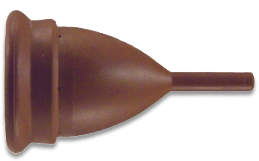
It is her, the American actress on the cover of this article. She filed the patent for the menstrual cup as we still know it today. Produced in vulcanized rubber, it was flexible and effective.
The heavy blow: World War II broke out. Rubber was requisitioned for the war effort. Production stopped dead.

3- 1950-2000: The wilderness years and the comeback
1939-1963: The failure of the Tassette
An entrepreneur bought Chalmers' patent and launched "La Tassette". Despite ads on Broadway, it was a commercial failure.
Why?
1. Puritanism: women did not dare to touch their intimate area.
2. Durability: once purchased, the customer did not come back (a nightmare for post-war boom capitalism!).

1970: The Tassaway (Disposable)
To counter the profitability problem, the brand launched a disposable cup. But suspicions of financial fraud sank the company in 1972.

1984: The Keeper (The comeback)
Lou H. Crawford relaunched the concept with "The Keeper" (still on sale!), made of latex. It was the beginning of the revival, driven by ecological movements in the USA.
4- 2000s: The explosion of brands
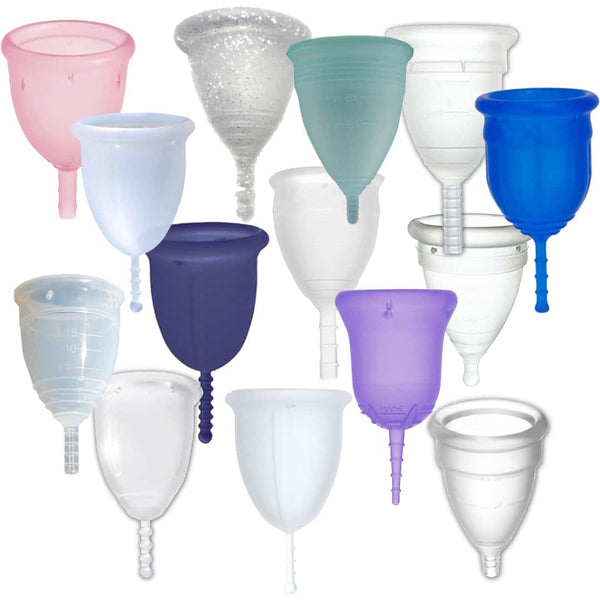
Dozens of brands emerged all over the world. Almost all of them were based on the first patents that had fallen into the public domain.
The only differences? The design of the stem (balls, ridges, hollow) and the color.
5- 2015: The technological breakthrough (La Cup Luneale)
For decades, the design didn't change: a funnel + a stem. In 2015, Teolab filed the patent for La Cup Luneale.
It is the first major innovation since 1935:
- Removal of the stem: No more irritation and discomfort.
- The MoonPad: An ergonomic grip zone for safe removal.
- Made in France: Local production and a purer material (Platinum medical silicone).

And tomorrow?
Congratulations on reaching the summit of this historical Everest! 🚩
Luneale was built with you. So, tell us: what is the next revolution? What is missing from your cycle to make it gentler?


Vos commentaires (7)
Instructif, merci pour l’étymologie et l’histoire des inventions qui se féminise ;)
Merci pour cet article très intéressant. Je ne pensais pas que l’invention datait de si longtemps ! … et pourtant, ce n’est finalement pas si compliqué, et tellement évident. Merci pour vos recherches et merci aux inventeurs !
Très intéressant, merci pour de travail de recherche !
Super intéressant… Je n’aurai jamais cru que c’était si vieux.
Merci.
Suis-je la 1ère ou la seule à avoir lu l’article jusqu’au bout ?? ;-)
En tous cas, merci pour ce superbe article sur l’histoire des cups menstruelle. J’ai trouvé ça très intéressant !
Premier article que je lis sur le sujet. Bravo à vous pour ces recherches.
Incroyable ! Je n’imaginais pas que c’était si ancien, et à 44 ans je pense enfin à essayer !
Un avis ? Une question ? Laissez un commentaire.